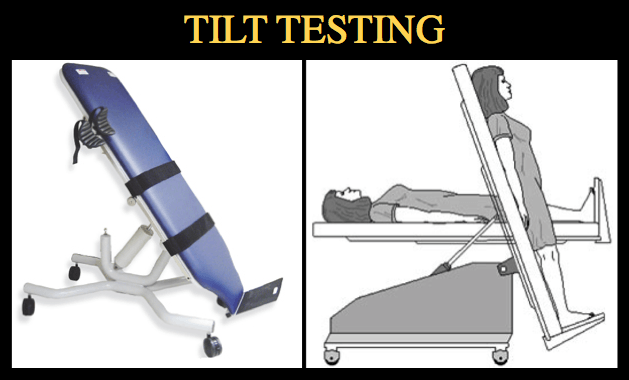
What is a Tilt Test?
The tilt test is a test that assesses someone’s response to orthostatic stress. Orthostatic stress is the fancy medical term for standing upright. The tilt test is also known as a tilt table test because it involves being basically strapped to a table that can tilt to different angles. A lot of the interest in tilt table tests originated from the air force. Years ago it was reported that up to 25% of those in the air force would pass out if they were in a straight upright standing position for a prolonged period of time. It was known that the tilt test could induce passing out in a subset of people and so it became a tool with which to assess people at risk for this. Nowadays the tilt test is used widely to diagnose syncope. Syncope is the medical term for passing out.
What Happens in the Tilt Test?
- In the tilt test, patients are strapped to a tilt table. It is basically a table capable of being swiveled to different angles. At 90 degrees a person would be upright and at 0 degrees they would be laying completely flat.
- The patient is awake and alert during the test. The angle of table tilt chosen is usually between 60 to 80 degrees, so upright but not all the way.
- The test involves basically laying there and not moving to see what happens. Heart rate and blood pressure are monitored closely throughout. Sometimes the angles are changed to assess the body’s response.
- Sometimes medicines will be administered during the tilt test to try and recreate stressful situations and provoke a response.
- The test typically last between 20-60 minutes, the patient is monitored throughout, and the test is of course terminated if there is a feeling of passing out, passing out, low blood pressure or too low a heart rate.
What Drugs May Be Given In The Tilt Test And Why?
Nitrates are a class of drug that cause dilation of the blood vessels and my provoke pooling of blood in the lower extremities in some people
Isoproterenol is a drug that speeds up the heart rate and is used to mimic the flight or fright stress response and the body’s reaction to it
Clomipramine is a drug that alters the levels of certain brain hormones such as serotonin thought to be central to the fainting reflex
Is Tilt Testing Safe?
- Tilt testing is generally safe, no deaths have been reported
- Some very long heart pauses have been reported, but the rhythm returns to normal when this happens
- Patient selection is important. The test should be avoided in those with significant heart disease
- Sometimes an irregular heart rhythm such as atrial fibrillation can occur but it usually spontaneously reverts to normal
How Often Are Tilt Tests Positive?
A positive tilt test is one that elicits a response, such as fainting, pre-fainting, low blood pressure, high or low heart rate.
Studies of tilt tests have shown that in those patients that have a history of fainting episodes, around half will have a positive test. If provocative drugs are given during the test then this number increases to two-thirds of patients.
What Information Are We Looking For In A Tilt Test
Two of the major causes of passing out are known as cardiogenic syncope and neurally mediated syncope. Cardiogenic syncope is related to underlying heart disorders such as heart failure and heart rhythm disorders. It’s important to identify those, because the underlying cause can often be treated. Neurally mediated syncope is related to brain causes. Sometimes there can be underlying structural brain disease that will initially be ruled out by the treating physician. Usually though no clear underlying cause is found and the syncope is thought to be due to a reflex within the brain that leads to passing out. The trigger for this is often orthostatic stress, the stress of standing for prolonged periods. Positive tilt tests are felt diagnostic of neurally mediated syncope.
Other information can be provided in the tilt test. In postural orthostatic tachycardia or P.O.T.S syndrome for example and other forms of dysautonomia or orthostatic intolerance, the heart rate response to standing can be important in diagnosis.
Are Tilt Tests Accurate?
The problem with neurally mediated syncope is that there is no clear definition of what it is! We basically label those with positive tilt tests as having neurogenic syncope. The big problem with this is that not all people with neurally mediated syncope will have a positive tilt test. In fact those with and without a positive test typically share the same symptoms. Scientifically speaking the sensitivity and the specificity of the test is not well known. Although having a positive tilt test can give a diagnosis of neurogenic syncope, a negative test doesn’t rule the diagnosis out.
Another problem with tilt tests is that the results recorded don’t correlate with clinical outcomes. For example, just because the heart rate may go low in the tilt test, doesn’t mean that a low heart rate is causing the syncopal event. This makes it hard to prescribe therapies based on the test findings. Tilt table tests should be used with care, and not be the sole basis for treatment decisions.
Thanks for the articles. In 2006 I had a syncope episode on a plane. I had felt terrible earlier in the day and in fact my wife drove to the airport for our flight. By the time we boarded the plane i felt O.K. However, as the plane was decending to land I started to feel quesy and before I knew it I passed out. When i regained consciousness i was taken to the local hospital, i passed all tests but failed the tilt table test. I received a pace maker. Since then i have continued to have episodes of syncope but have not passed out again. Recently, i received a new pacemaker as the battery in the original expired. I am currently having episodes almost daily and they seem to happen at roughly the same time each day. They begin with a headache then the feeling o lethargy comes over me. Usually these episodes resolve within an hour or so. Otherwise, i am a healthy 76 year old. I exercise about 5-6 days a week. Wondering whether my experience is normal and is there anything i might consider doing to lessen the episodes. Thanks, Tom
I’m opposite of most trying hard went to gym instructor told me after peddling 10-15 mins something was wrong with me need see Dr don’t know how many I had seen before but when I stand by drops did test for lungs they are ok but said when I stopped peddling my BP dropped too fast.. that’s end of that story! No one knows why
I attended a Tilt Table Test yesterday and I only lasted 1 minute on the table when the test began they elevated the table then upon the first tilt the ended the test as heart rate shot up fast but not abnormally fast as they stated. but they didn’t explain what this means for me but instead assigned me to a cardiologist and now awaiting appointment or phone call. What does this mean for me?
What does a syncope after 37 minutes on tilt table indicate?
Happened to me at 38 minutes too.
I had a hysterectomy in 2009 and my BP dropped so significantly thatmy surgeon had debated on taking me back to the operating room.My face was pale grey and my BP was low. She did a vagel tilt and my BP came back up. I do have some tachycardia episodes but mostly when I come out of having surgery.Should I be concerned?
I am a 19 year old female. I had SVT and got a cardiac ablation last June. I still feel horrible and just got a table tilt test done. I didn’t faint but was really sweaty and pretty close to fainting. They said my heart rate and blood pressure was all over the place and that my heart rate would take off and a nervous system “can’t remember the name” would try to stop it. What do you think they are going to do? Thank you
My tilt table resulted in a complete syncope about 10 minutes in. I went from 100% conscious and lucid to instantly unconscious. I was talking and the technician said I went out mid-sentence. I threw up afterward, which the technician said was unusual because people usually throw up before they have a positive response. I was very sick the entire rest of the day. Couldn’t even keep water down. That was the worst episode I’ve ever had and I think I was only tilted to 80 degrees. Still don’t know what the underlying cause is but was told it is cardiogenic. I am unmedicated but haven’t had an episode in years, and the last one I had was just because I stood up too fast. It was much worse when I was younger but I do still have a very strangely low resting heart rate and can’t ride roller coasters 🙁
Grace mine was much worst until menopause. Now it is barely a glitch in my system. It is just a thought since I saw your age
What , if there is any, recovery time after the test. Do I need to have a driver come with me.
I would just in case. I passed out in about ten minutes and had an IV administered. There was no way I could have driven home. I was really sick after and was dizzy and nauseous for the rest of the day.
It would be wise…just got home w/my wife following her 6AM TT. She tells me she was hanging onto the car’s grab bar for dear life for the 40 min ride home. She gas slept continuously since returning and I expect I will not see her for another 8 hours or so.
Love the “practice”” they are doing on me. Mine started at menopause. Failed tilt table test….went out mid-sentence and told attendants it was coming on as I felt nauseous. Keep very hydrated and watch my blood pressure…I can tell when it goes low and I constrict muscles….sometimes I can divert
I did the tilt table test just recently and I lost consciousness after about 5 minutes, I remember the nurses saying my heart rate was below 28 and I told them everything was going white and poof
Can other health conditions such as overactive thyroid affect a tilt table result?